> For the complete documentation index, see [llms.txt](https://ticketking.xyz/docs/llms.txt). Markdown versions of documentation pages are available by appending `.md` to page URLs; this page is available as [Markdown](https://ticketking.xyz/docs/tickets/closing-a-ticket.md).
# Closing a ticket
Every close-behavior setting in Ticket King, and what each one does.
Closing a ticket generates a transcript, posts the close log, DMs the author if configured, and removes the channel or archives the thread.
## How to close
Run this in any ticket channel:
```
/close [reason]
```
Or click the **Close** button on the ticket controls.
If **Close Requires Reason** is on, you must give a reason. If you run `/close` without one, the bot replies that a reason is required, so run it again with `reason:"..."`. If you use the **Close** button instead, it opens a short pop-up that asks for the reason. There is no other yes or no confirmation step for a normal close.
## Asking the author to approve a close
Use `/closerequest` when you want the ticket author to agree before the ticket closes:
```
/closerequest [reason]
```
This posts a message that pings the author with **Accept** and **Deny** buttons. If the author clicks Accept, the ticket closes. You need to be able to manage the ticket to use this command.
## Close-behavior settings
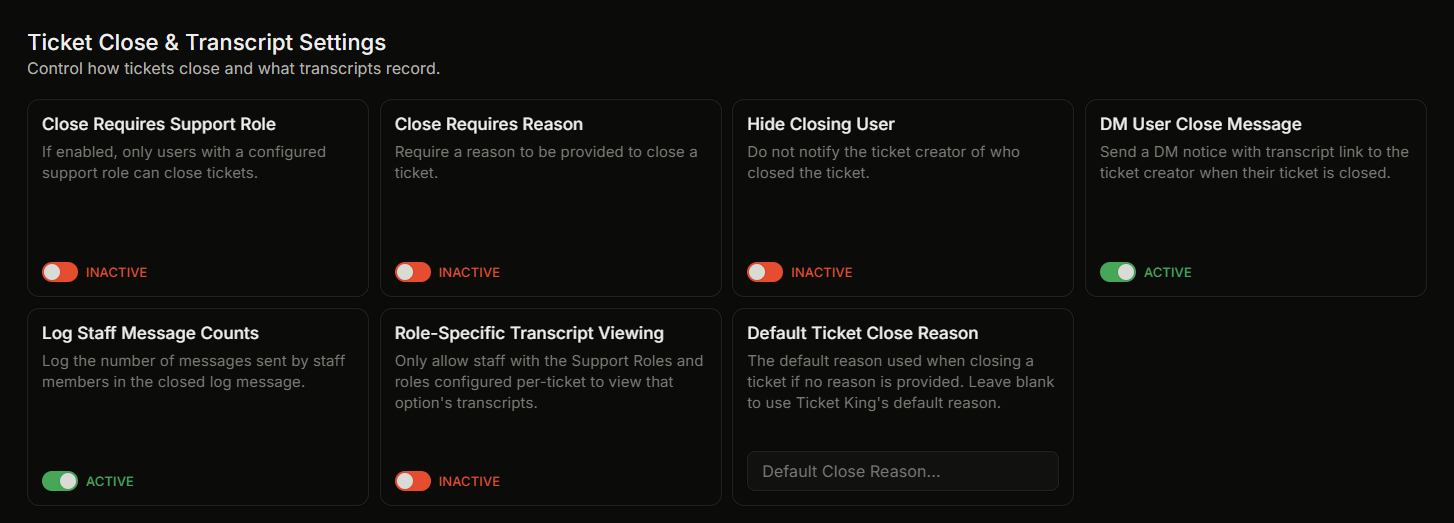
All of these are in **Settings, Ticket Close & Transcript Settings**. None of them are premium.
| Setting | Default | Behavior |
| ------------------------------------ | ---------------------------------------------------- | -------------------------------------------------------------------------------------------------------------------------------------------------------------------------------------------------------------------------------------------------------------------- |
| **Close Requires Support Role** | off | When on, only users with a support role can close. Ticket authors can no longer close their own ticket. |
| **Close Requires Reason** | off | When on, closing without a reason in the command opens a pop-up that asks for one. |
| **Hide Closing User** | off | When on, the ticket creator is not told who closed their ticket. The close notice they receive and the transcript footer show "Staff Team" instead of the closer's name. The staff close-log still records the real closer. |
| **DM User Close Message** | **on** | DMs the ticket author a close notice with the transcript link. On a premium server with Ticket Rating on, the DM also includes the 5-star rating row. |
| **Log Staff Message Counts** | **on** | Adds a "Staff Message Count" field to the close-log embed, listing each staff member's message count in the ticket. Counts anyone with a support role, anyone with a role that has Discord's Administrator permission, and the server owner. Bots are never counted. |
| **Role-Specific Transcript Viewing** | off | Limits transcript access to the roles that were attached to that specific ticket, instead of the current panel roles. See [Role-Specific Transcript Viewing](/docs/transcripts/role-specific-viewing.md). |
| **Default Ticket Close Reason** | empty (Ticket King uses its built-in default reason) | The reason text used when no reason is given. |
## What members and staff see on close
### In the closed-tickets log channel
A "Ticket Closed" embed that includes:
* **Ticket Name**
* **Ticket Author**
* **Closed By** (the staff member who closed it, or a note that the ticket was closed automatically for auto-closes)
* **Claimed By** (only if the ticket was claimed)
* **Opened Date** and **Close Date**
* **Close Reason**
* **Staff Message Count** (if **Log Staff Message Counts** is on, listing each staff member's count, highest first). If the ticket had more staff than fit in one field, the busiest are listed and the rest are summarized as a trailing `[ +N ]`.
* A **View Transcript** link button (if a transcript was generated)
### In the author's DMs (if DM User Close Message is on)
The author is DM'd a close notice with the transcript link. On a premium server with Ticket Rating on, the DM also includes a 5-star rating row.
If the author has DMs turned off for the server, the DM does not arrive. The ticket still closes.
## What happens to the channel
| Ticket style | On close |
| --------------------------------------------------------- | ------------------------------------------------------------------------------------- |
| **Text channel** | The channel is deleted. There is no archive option for text channels. |
| **Thread** with Archive Thread Tickets set to **Archive** | The thread is renamed with a resolved prefix, locked from new messages, and archived. |
| **Thread** with Archive Thread Tickets set to **Delete** | The thread is deleted. |
Set thread close behavior in **Settings, Ticket Style and Claiming Settings, Archive Thread Tickets**. The default is **Delete**.
## Who can close
By default, anyone who can manage the ticket can close it, and so can the ticket author. A user can manage a ticket if they have Manage Channels or Manage Server, or are the server owner, or hold an authorized support role. Discord Administrator also passes.
With **Close Requires Support Role** on, only users with a support role can close. The ticket author can no longer close their own ticket.
See [The two layers of permissions](/docs/permissions-and-your-support-team/two-layers.md) for who counts as a manager.
## Closing is permanent
A closed ticket cannot be reopened. If the member needs more help, they open a new ticket. The transcript is still available to authorized staff.
## Related
{% content-ref url="/pages/Gjspl5mwSsfoYl8bZR1H" %}
[What's in a transcript](/docs/transcripts/whats-in-a-transcript.md)
{% endcontent-ref %}
{% content-ref url="/pages/BdzAJh6nhAgNyRVnzgM9" %}
[Log channels](/docs/logging/three-log-channels.md)
{% endcontent-ref %}
{% content-ref url="/pages/IF5BZ0r8Id5ZekK1gryx" %}
[Inactivity rules](/docs/tickets/inactivity-rules.md)
{% endcontent-ref %}
---
# Agent Instructions
This documentation is published with GitBook. GitBook is the documentation platform designed so that both humans and AI agents can read, navigate, and reason over technical content effectively. Learn more at gitbook.com.
## Querying This Documentation
If you need additional information that is not directly available in this page, you can query the documentation dynamically by asking a question.
Perform an HTTP GET request on the current page URL with the `ask` query parameter, and the optional `goal` query parameter:
```
GET https://ticketking.xyz/docs/tickets/closing-a-ticket.md?ask=&goal=
```
`ask` is the immediate question: it should be specific, self-contained, and written in natural language.
`goal` is optional and describes the broader end goal you are ultimately trying to accomplish on behalf of the user. GitBook uses it to tailor the answer towards what is most useful for that goal.
The response will contain a direct answer to the question and relevant excerpts and sources from the documentation.
Use this mechanism when the answer is not explicitly present in the current page, you need clarification or additional context, or you want to retrieve related documentation sections.