> For the complete documentation index, see [llms.txt](https://ticketking.xyz/docs/llms.txt). Markdown versions of documentation pages are available by appending `.md` to page URLs; this page is available as [Markdown](https://ticketking.xyz/docs/logging/log-embed-contents.md).
# What a log entry shows
What a log entry tells you, and where the transcript link is.
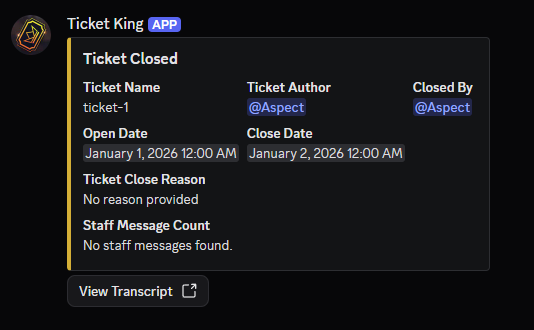
Each log channel posts a tidy embed when its event happens. You do not need to memorize the exact fields. Here is what each one gives you at a glance.
## Open and close logs
The open-ticket log and close-ticket log each show who the ticket is for, who acted on it, and when. The close log adds the close reason and a **View Transcript** button that opens the full conversation. If you turned on **Log Staff Message Counts**, the close log also lists how many messages each staff member sent in that ticket, so you can see who did the work. That list covers everyone who handled the ticket, not just your support roles: members with a role carrying Discord's Administrator permission and the server owner are counted too, even when they were never given a support role.
The transcript link opens in the transcript viewer at `transcripts.ticketking.xyz`. See [Transcript capture limits](/docs/logging/transcript-capture-limits.md) for how much of the conversation is saved.
## Rating log (Premium)
When a member rates a closed ticket, the [Ticket Rating](/docs/ticket-rating/what-ticket-ratings-are.md) log shows the ticket, the star score, the member's written comment (if your rating mode collects one), and buttons to open the transcript and the ticket's dashboard page.
## The close DM to the member
When **DM User Close Message** is on (the default), the ticket author also gets the close notice as a direct message, including the transcript link. On a Premium server with Ticket Rating on, that DM also asks them to rate the ticket. The member only receives it if their Discord settings allow direct messages from the server.
## Related
{% content-ref url="/pages/BdzAJh6nhAgNyRVnzgM9" %}
[Log channels](/docs/logging/three-log-channels.md)
{% endcontent-ref %}
{% content-ref url="/pages/wCbUHb75fVzWZWVTbURD" %}
[Transcript capture limits](/docs/logging/transcript-capture-limits.md)
{% endcontent-ref %}
---
# Agent Instructions
This documentation is published with GitBook. GitBook is the documentation platform designed so that both humans and AI agents can read, navigate, and reason over technical content effectively. Learn more at gitbook.com.
## Querying This Documentation
If you need additional information that is not directly available in this page, you can query the documentation dynamically by asking a question.
Perform an HTTP GET request on the current page URL with the `ask` query parameter, and the optional `goal` query parameter:
```
GET https://ticketking.xyz/docs/logging/log-embed-contents.md?ask=&goal=
```
`ask` is the immediate question: it should be specific, self-contained, and written in natural language.
`goal` is optional and describes the broader end goal you are ultimately trying to accomplish on behalf of the user. GitBook uses it to tailor the answer towards what is most useful for that goal.
The response will contain a direct answer to the question and relevant excerpts and sources from the documentation.
Use this mechanism when the answer is not explicitly present in the current page, you need clarification or additional context, or you want to retrieve related documentation sections.