> For the complete documentation index, see [llms.txt](https://ticketking.xyz/docs/llms.txt). Markdown versions of documentation pages are available by appending `.md` to page URLs; this page is available as [Markdown](https://ticketking.xyz/docs/it/registrazione-log/log-embed-contents.md).
# Cosa mostra una voce di log
Cosa ti indica una voce di log e dove si trova il link della trascrizione.
Ogni canale di log pubblica un embed ordinato quando si verifica il suo evento. Non devi memorizzare i campi esatti. Ecco cosa ti mostra ciascuno a colpo d'occhio.
## Log di apertura e chiusura
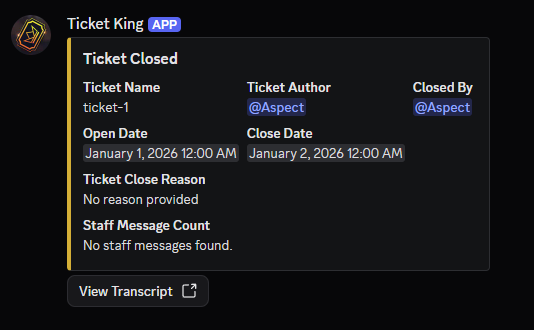
Il log di apertura ticket e il log di chiusura ticket mostrano entrambi per chi è il ticket, chi vi ha agito e quando. Il log di chiusura aggiunge il motivo della chiusura e un **Visualizza trascrizione** pulsante che apre la conversazione completa. Se hai attivato **Registra il conteggio dei messaggi dello staff**, il log di chiusura elenca anche quanti messaggi ha inviato ciascun membro dello staff in quel ticket, così puoi vedere chi ha fatto il lavoro.
Il link della trascrizione si apre nel visualizzatore di trascrizioni su `transcripts.ticketking.xyz`. Vedi [Limiti di acquisizione delle trascrizioni](/docs/it/registrazione-log/transcript-capture-limits.md) per sapere quanta parte della conversazione viene salvata.
## Log delle valutazioni (Premium)
Quando un membro valuta un ticket chiuso, il [Valutazione del ticket](/docs/it/valutazione-del-ticket/what-ticket-ratings-are.md) log mostra il ticket, il punteggio in stelle, il commento scritto del membro (se la modalità di valutazione ne raccoglie uno) e i pulsanti per aprire la trascrizione e la pagina della dashboard del ticket.
## Il DM di chiusura al membro
Quando **Messaggio di chiusura all'utente via DM** è attivo (l'impostazione predefinita), l'autore del ticket riceve anche l'avviso di chiusura come messaggio diretto, incluso il link alla trascrizione. Su un server Premium con Valutazione ticket attiva, quel DM chiede anche di valutare il ticket. Il membro lo riceve solo se le impostazioni di Discord consentono i messaggi diretti dal server.
## Correlati
{% content-ref url="/pages/95622158d1f4ffa67cb056806b781f97f9e032f4" %}
[Canali di registro](/docs/it/registrazione-log/three-log-channels.md)
{% endcontent-ref %}
{% content-ref url="/pages/5f19a583493d629b3ca01c1bde772e8eab6575ff" %}
[Limiti di acquisizione delle trascrizioni](/docs/it/registrazione-log/transcript-capture-limits.md)
{% endcontent-ref %}
---
# Agent Instructions
This documentation is published with GitBook. GitBook is the documentation platform designed so that both humans and AI agents can read, navigate, and reason over technical content effectively. Learn more at gitbook.com.
## Querying This Documentation
If you need additional information that is not directly available in this page, you can query the documentation by asking a question.
Perform an HTTP GET request on the following URL with the `ask` and `goal` query parameters:
```
GET https://ticketking.xyz/docs/it/registrazione-log/log-embed-contents.md?ask=&goal=
```
`ask` is the immediate question: it should be specific, self-contained, and written in natural language.
`goal` is what the user is ultimately trying to achieve, the reason they need the answer. Sharing it helps GitBook give you a better, more relevant answer. A goal is most helpful when it describes the outcome the user wants rather than restating the question. For example, with `ask=how do I create an API token`, a goal like `automate deployments from our CI pipeline` lets GitBook tailor the answer to that use case.
The response will contain a direct answer to the question and relevant excerpts and sources from the documentation.
Use this mechanism when the answer is not explicitly present in the current page, you need clarification or additional context, or you want to retrieve related documentation sections.